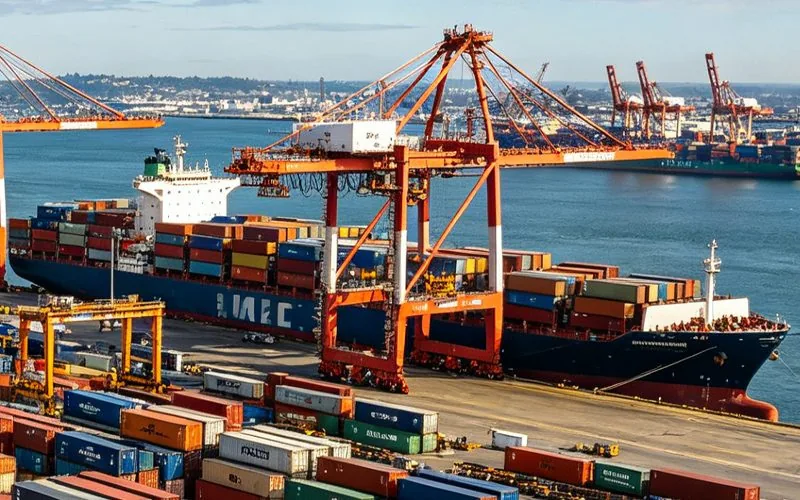
Many exporters look at a US duty bill and wonder: why is the rate different for what looks like the same product, how is the rate decided, and can it be reduced? This article explains how US import duty is actually calculated, and how to reduce it without taking on risk.
1. The Duty Formula
Duty payable = Customs Value × Applicable Rate
Customs value is not simply the FOB invoice value. US Customs determines it under the transaction value method, which normally includes:
| Included | Notes |
|---|---|
| Price actually paid for the goods | The commercial invoice amount |
| International freight | Freight to the US port of entry |
| Insurance | Cargo insurance cost |
| Certain assists | Items the buyer supplies free, such as moulds or design work |
This is why "under-declaring the goods value" means under-declaring freight too — US Customs has extensive data to compare against, so simply writing a lower invoice number is easily detected.
2. Where the Rate Comes From: HS Classification Comes First
The US uses the HTSUS (Harmonized Tariff Schedule of the United States). The first six digits match the international HS code; the remaining digits are US-specific.
The same product classified a few digits apart can carry a rate several times higher. Examples:
| Product | Possible classification | Why it matters |
|---|---|---|
| Outdoor furniture | Metal-framed vs wooden vs plastic furniture | Different chapters, different rates |
| LED lighting | Lighting apparatus vs parts of lamps | Finished goods and parts can carry different rates |
| Injection moulds | The mould itself vs a machine part | Classification determines whether additional tariffs apply |
The three tests US Customs applies:
- Material — same use, different material, often a different code;
- Function and use — the principal function decides classification;
- Whether goods are a set — a set may be classified as a whole, or entered separately.
Classification is where the effort pays off most — correct classification avoids both overpayment and the penalties that follow an incorrect entry. Our US customs brokers classify every shipment before it sails, and will review a code you already have rather than simply accepting it.
3. It Is Not Just Duty: MPF and HMF
Many quotes discuss "duty" alone, but two further charges are mandatory on most entries. They are not duty, but they are still payable:
| Charge | Full name | How it is calculated | Applies to |
|---|---|---|---|
| MPF | Merchandise Processing Fee | A percentage of value (recently around 0.3464%, with minimum and maximum caps) | Formal entries |
| HMF | Harbor Maintenance Fee | A percentage of value (recently around 0.125%) | Ocean imports only — not air |
These belong in your landed-cost calculation. Because MPF has a floor and a ceiling, it is charged at the minimum on low-value shipments and capped on very high-value ones — which means MPF can be disproportionately heavy on small shipments.
⚠️ Rates and caps change with US regulation. The figures above are for estimation only. The actual amount is subject to the broker's current calculation and the CBP bill, and should be reconfirmed at the time of quoting.
4. Additional Tariffs: Why Your Product Rate Is So High
Beyond the base Most-Favoured-Nation (MFN) rate, some Chinese-origin products carry additional tariffs — usually the real reason a competitor's rate looks lower than yours.
| Type | Notes |
|---|---|
| Base rate (MFN / Column 1 General) | The standard rate for most trading partners |
| Section 301 tariffs | Additional duty on specified Chinese product lists, determined by HS code |
| Anti-dumping / countervailing duty (AD/CVD) | Applied to specific categories such as certain furniture, mattresses and solar products — rates can be very high |
The key point: additional tariffs are determined by which list your HS code falls under, not by how you describe the product. The same product classified into a different code can land under a different list, with a very different final rate.
This is why classification must come before pricing. Discovering an additional tariff after you have quoted your customer means you absorb the loss.
5. Three Ways to Lower Duty Compliantly
1. Classify accurately
Rates vary widely between codes for the same product. Professional classification avoids both overpayment and the penalties of an incorrect entry. It is the only lever that lowers cost and risk at the same time.
2. Declare value honestly
Declare the true transaction value, including freight and insurance as required. Over-declaring simply gives money away; under-declaring plants a landmine — if it surfaces, back duty, penalties and a place on the examination list cost far more than was saved.
3. Review the additional tariff lists
Confirm whether your HS code falls under an additional tariff list, and whether an exclusion or an alternative classification is available. This has to happen before shipment — there is no room to manoeuvre afterwards.
⚠️ On the de minimis threshold
The US previously allowed a USD 800 de minimis exemption (Section 321). That treatment has been withdrawn for Chinese-origin shipments as of 2025, and the surrounding policy continues to change.
If your model depends on low-value air freight parcel shipments entering duty free, re-cost it against current rules rather than the old USD 800 assumption.
6. FAQ
Q: Where can I look up US duty rates? A: The HTSUS database gives the base rate by HS code. Additional tariffs and AD/CVD must be checked against separate lists, so it is best to have a licensed broker classify the goods and give you a combined rate.
Q: How does duty work under FOB versus DDP? A: Under FOB the importer pays duty. Under FCL DDP the quote includes estimated duty paid on your behalf, reconciled against the final assessment, so the quote is the door price.
Q: Can I declare a lower value? A: No. That is a false declaration — at best back duty and penalties, at worst damage to your customs record and a place on the intensive examination list. Honest declaration is the basis of stable long-term shipping.
Q: Who collects MPF and HMF? A: Both are official US Customs and Border Protection charges, paid by the broker at entry and itemised separately on the duty statement.
Q: When do I receive the duty invoice? A: After release, the broker issues the duty statement and payment receipt. DDP customers can check every line against it, fully traceable.
Q: What if the classification is wrong? A: A correction can be filed with CBP within the allowed period (Post Summary Correction), and overpaid duty can be refunded. Voluntary correction is far cheaper than being found out.
7. How We Can Help
Harmony Shipping Services Limited provides China export to USA forwarding with a US-based customs team experienced in HS classification and duty entry, and DDP door-to-door pricing that includes duty, MPF and HMF paid on your behalf — every line item verifiable and fully compliant.
Want to know which HS code your product falls under and the combined rate? Send the product name, material and use, and we will provide a classification view and a combined rate estimate including any additional tariffs.