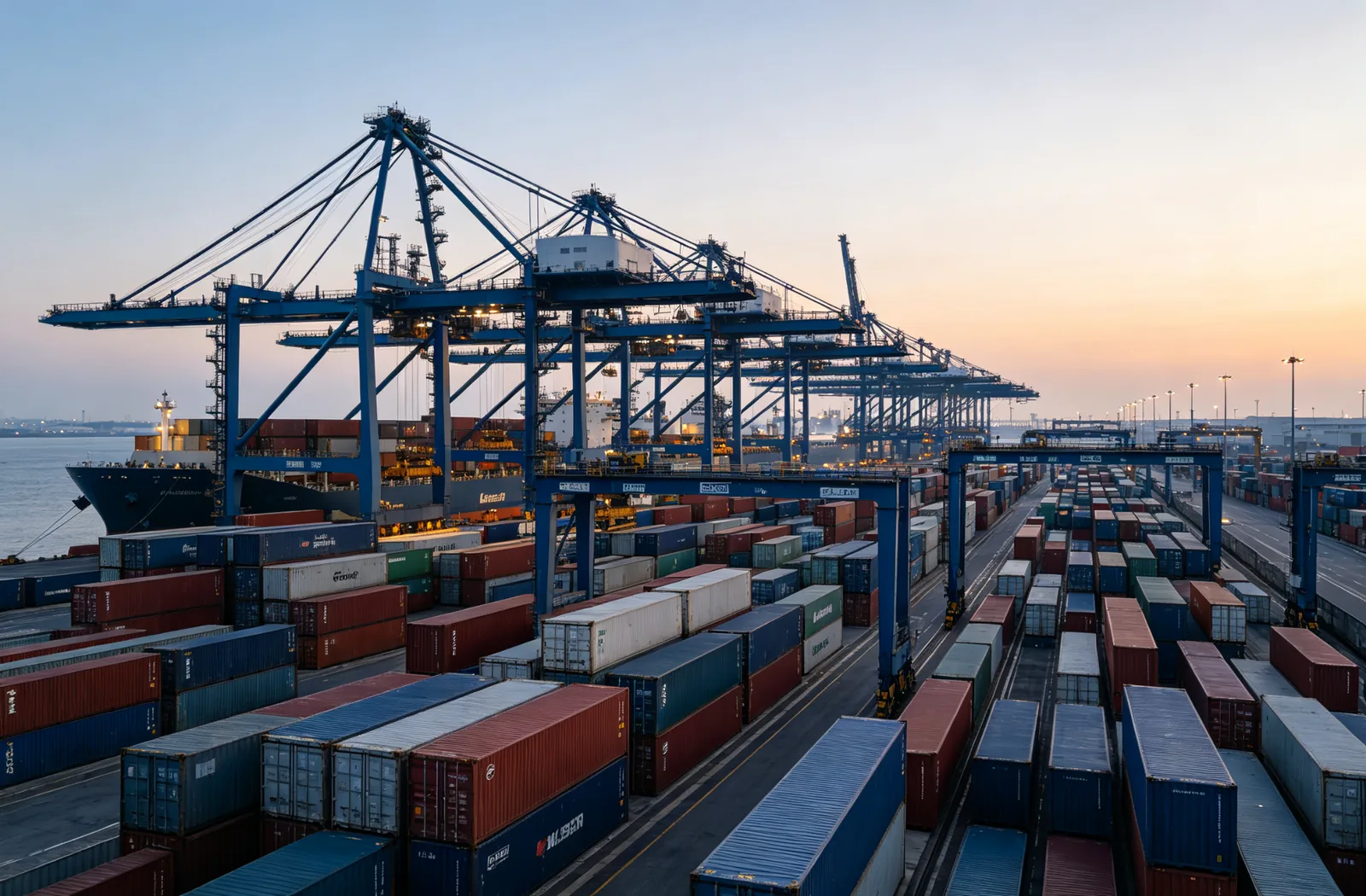
DDP Shipping from China to USA: What's Included and What It Costs
One price from your factory door to your US delivery address, with import duty paid by us. This page explains exactly what a DDP quote covers, what it does not, and how to read one before you compare numbers.
What DDP actually means
DDP stands for Delivered Duty Paid. Under Incoterms, the seller carries every cost and risk until the goods reach the named destination — including export clearance, freight, import clearance and the import duty itself.
The practical effect for a US buyer is simple: you place an order, you receive goods at your address, and you never open a customs account, post a bond, or file a single entry. The landed cost is known before the shipment leaves China.
The trade-off is that someone has to legally be the importer of record — the party CBP holds responsible for the entry, the declared value and the duty. Under our DDP service that party is us, acting through our own US entity and bond, not through yours.
- No US entity required
You do not need a US company, an EIN for customs purposes, or a bond to buy DDP. That is the main reason first-time importers choose it.
- One invoice, one currency
Freight, duty and delivery arrive as a single number, so you can calculate margin before the goods ship rather than after the entry is liquidated.
- Duty risk sits with us
If the classification turns out to carry a higher rate than expected, that is our exposure under DDP, not a surprise invoice to you.
What a DDP quote includes — and what it does not
This is the single most useful table on the page. Ask any forwarder to match it line by line before you sign.
| Included in a DDP quote | Usually NOT included |
|---|---|
| Factory pickup and inland drayage | Customs examination fees if CBP selects the container |
| Export declaration and AMS filing | Detention and demurrage beyond free time |
| Freight — by sea or by air, depending on the booking | Storage if the receiver cannot accept delivery |
| ISF 10+2 filing | Re-delivery after a failed appointment |
| Destination terminal handling and documentation | Cargo insurance (optional, priced on declared value) |
| US import entry, customs bond and duty payment | Product certifications such as FDA registration or FCC testing |
| MPF (merchandise processing fee) and HMF (harbor maintenance fee) | Anti-dumping or countervailing duty, unless quoted separately |
| Container pickup, door delivery and empty return | Duty on value declared below the true transaction value |
The right-hand column is where cheap quotes hide their margin. A quote that omits examination fees is not wrong — it is simply incomplete.
DDP vs DAP vs CIF vs FOB
Who pays for what, at each stage. The only line that separates DDP from DAP is duty.
| Term | Export clearance | Freight | Insurance | Import clearance | Import duty | Delivery to door |
|---|---|---|---|---|---|---|
| EXW | Buyer | Buyer | Buyer | Buyer | Buyer | Buyer |
| FOB | Seller | Buyer | Buyer | Buyer | Buyer | Buyer |
| CIF | Seller | Seller | Seller | Buyer | Buyer | Buyer |
| DAP | Seller | Seller | Seller | Seller | Buyer | Seller |
| DDP | Seller | Seller | Seller | Seller | Seller | Seller |
If you already hold a US entity and a customs bond, DAP is normally cheaper — you pay duty directly instead of having us advance it.
How landed cost is calculated
A DDP price is not a freight rate with a markup. It is a stack of six cost lines.
Landed cost =
    goods value (FOB)
  + international freight
  + insurance (if taken)
  + import duty          (HS code rate x value)
  + MPF                  (value x 0.3464%, min/max apply)
  + HMF                  (value x 0.125%, sea freight only)
  + destination charges and final delivery
Duty
Set by the HS classification and the country of origin. It is the largest variable in most landed cost gaps, and the reason classification accuracy matters more than freight negotiation.
MPF and HMF
MPF is a merchandise processing fee at roughly 0.3464% of value with an annual minimum and maximum. HMF is a harbor maintenance fee at 0.125% of value on sea shipments only. Both are adjusted periodically — confirm current figures.
Destination charges
Terminal handling, documentation, chassis, pier pass and the final delivery leg. These vary by port and by how far the delivery address sits from the terminal.
Fee percentages above are indicative and change with Federal Register updates. We quote against the rates in force at the time of entry.
The four stages of DDP door to door
Where the money is spent, and who carries the risk at each stage.
Origin: pick up and export
We collect from your factory, load and seal the container, file the export declaration and complete AMS. Nothing is charged to you at this stage under a DDP quote.
Transit: freight and ISF
Freight is booked and paid by us. ISF 10+2 is filed before departure, which is the filing that carries penalties if it is late or wrong.
Arrival: declaration and duty
Import entry is filed with CBP, duty, MPF and HMF are paid by us, and the shipment is released. This is the stage that separates DDP from DAP.
Delivery: final mile and empty return
The container is collected from the terminal, delivered to your address, unloaded and returned inside the free time window. Detention is our risk, not yours.
When DDP is the wrong choice
DDP is not automatically better. In these four situations it usually costs you more than the alternative.
You already have a US entity and bond
DDP means the forwarder advances duty and carries the classification risk — both are priced into the rate. If you can file your own entry under DAP, you normally pay less.
You are a large retailer with a nominated broker
Major retail buyers control their own customs entry and will not accept a third party as importer of record. DDP simply is not on the table.
The duty rate is very high
On high-tariff goods the forwarder is funding a large duty bill for 30 to 60 days. That carrying cost appears in the price, and it is not small.
You ship small volumes frequently
DDP is priced per shipment. Many small shipments carry more fixed cost per unit than a consolidated entry under your own bond.
Five traps in a low DDP quote
Any one of these can turn the cheapest quote into the most expensive shipment.
| Trap | What actually happens |
|---|---|
| MPF and HMF left out | They appear as a destination charge after arrival, usually a few hundred dollars per container. |
| Duty quoted at a lower classification | The entry is filed at a cheaper HS code, CBP reclassifies later, and the difference plus interest lands on someone. |
| Quote ends at the port | "Door to door" that stops at terminal handling is not door to door. Read what address is named. |
| Free time not stated | Detention starts the day after free time expires. If the origin side books too tight a window, the receiver pays. |
| Examination fees excluded | A single intensive exam can cost more than the freight. Ask explicitly who pays if CBP pulls the container. |
DDP Shipping FAQ
Is DDP legal for US imports?
Yes. DDP is a standard Incoterms term and is widely used for US imports. What matters legally is that the entry declares the true transaction value, the correct classification and the actual country of origin. Problems arise from misdeclaration, not from the DDP structure itself.
Who is the importer of record under your DDP service?
We are. The entry is filed through our own US entity under our own customs bond, so CBP holds us responsible for the entry rather than you. This is why you do not need a US company, an EIN for customs purposes, or a bond to buy DDP from us.
Does DDP cover customs examination fees?
Normally no, and this is the most common gap between quotes. If CBP selects the container for examination, the exam, devanning and storage charges are usually billed separately. Ask before you book, and get the answer in writing.
DDP or DAP — which is cheaper for a US buyer with a US entity?
DAP is usually cheaper, because you file your own entry and pay duty directly instead of the forwarder advancing it and pricing the carrying cost into the rate. Choose DDP when you do not want to deal with customs at all; choose DAP when you already have the account and the bond.
Can LCL shipments go DDP, or only full containers?
Both can, but the economics differ. On LCL the destination side involves consolidation and devanning, which adds handling charges and time. For volumes above roughly 15 cubic metres, a full container is normally cheaper and simpler.
How is a DDP price structured — per container or per kilo?
Per shipment. Sea freight bookings are priced per container, air freight per chargeable weight, and duty by declared value. A DDP total combines all of these plus fixed service costs, which is why DDP quotes are specific to a shipment rather than a public rate card.
What happens if my shipment is held by customs?
We handle the response: supplying additional documentation, responding to a Request for Information, or arranging an examination. The timeline depends on the reason for the hold. Under DDP the operational work is ours; examination costs are normally passed through.
Are Section 301 tariffs covered under DDP?
Section 301 duties are assessed on top of the base rate for many China-origin products. Whether they are inside the DDP price depends on how the quote was built. Confirm at quotation stage, in writing, exactly which duty lines are included.
Get a DDP quote with the scope spelled out
Send the product, HS code, value and delivery address. We will come back with a line-by-line DDP breakdown that says what is included, what is not, and which duty lines apply.
How the container itself is planned — container sizes, load ports and transit times — is covered on ocean freight and FCL. The customs filing side, including certification requirements, is on US customs clearance.