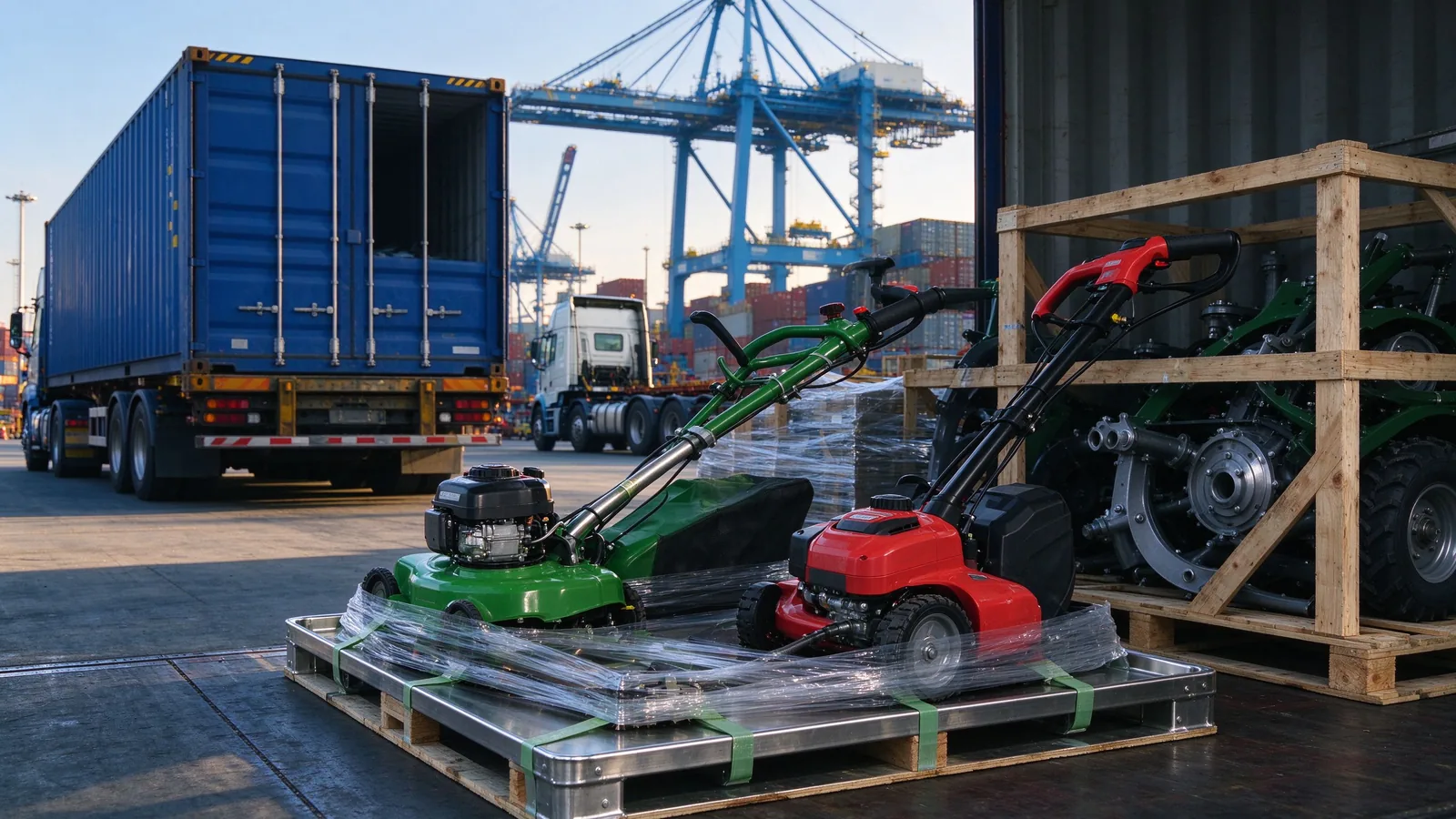
Most garden machinery exporters do not lose money on the order. They lose it before the container is loaded, when the wrong declaration path is chosen: a gasoline trimmer still holding fuel, or a lithium-ion model booked as ordinary cargo, becomes an exam or a rework at the port of discharge. Moving trimmers and mowers to the US by FCL ocean freight is a mature route. What decides your cost is the power source, the watt-hour rating, and how the cargo is blocked and braced.
Why the power source is the first decision
Gasoline and lithium-ion trimmers need different paperwork, carrier acceptance rules and container planning. Split your product list by power type before you request rates.
| Item | Gasoline / 2-stroke | Lithium-ion battery |
|---|---|---|
| Main compliance focus | EPA emissions, nameplate matches certificate | UN38.3, battery transport rules, FCC if wireless |
| Declaration angle | Depends on residual fuel and vapour | Usually UN3481 in equipment, UN3480 if packed alone |
| Documents | Engine compliance papers, MSDS if requested | UN38.3 report, MSDS, battery spec sheet |
| Loading notes | Drain fuel, ventilate, avoid fuel odour | Insulate terminals, prevent short circuit, no heavy stacking |
Look at what is still inside the machine, then check whether the certificate matches the model number. Orders sent by air freight to the USA face stricter battery rules than ocean freight.
Lithium-ion models: watt-hours are the booking gate
The watt-hour rating and packing configuration decide whether a battery trimmer can sail, not the brand.
- Watt-hours: complete packs commonly sit around 100Wh, and anything above 100Wh is normally managed as Class 9 dangerous goods, which tightens booking conditions.
- UN38.3 and MSDS: the report must cover the exact cell or pack model you ship. Change the cell supplier and the report usually has to be reissued.
- Packing configuration: installed in the machine, packed with it, or shipped as a standalone battery carton are three different cases, and standalone cartons are usually the hardest to book.
⚠️ Battery transport rules are revised with each edition of the international regulations, so watt-hour bands, marks and labels change with them. Confirm against the carrier's current acceptance rules and the official regulations in force at the time of shipping.
Gasoline models: EPA, CARB and nameplate consistency
For a gasoline trimmer the central question is not "can it clear customs" but "can this engine legally be sold in the US."
- EPA emissions: the rules normally target spark-ignition engines and define which displacement ranges they cover, but the scope stated in the current EPA rules and on your certificate is what counts.
- CARB (California): California sales usually need extra CARB documentation, and an EPA certificate does not cover it.
- Nameplate consistency: the nameplate model and the emissions label should match the certificate, and an engine swap very often means the certificate must be re-matched.
- DOT: those rules mostly bite on the road and transport side, so treat them as a packaging, labelling and carrier-acceptance question.
⚠️ Emissions scope and exemption conditions are adjusted over time. Confirm against current EPA and CARB rules and with your customs broker before shipping.
Which certificates to do: work backwards from the channel
| Sales channel | Usual compliance direction | What to check |
|---|---|---|
| Big-box and hardware chains | Full machine safety certification (UL/ETL or equivalent) | Chains usually want a third-party certificate; self-declaration is often rejected |
| Marketplace private label | Platform rules + battery transport compliance + FCC where relevant | Platforms scrutinise battery documentation closely |
| Smart / remote-controlled models | Wireless module brings FCC into play | An existing FCC ID can often be reused if the module and its use are unchanged |
| Pure wholesale, buyer owns compliance | Buyer's written requirements | Put the responsibility split in writing before production |
Fix the end channel first, then choose which tests to run, then book lab time. Testing everything is slow and expensive.
Wood packing and bracing: IPPC is the top fine trigger
- Wooden crates, pallets and skids must be heat-treated and stamped. Unmarked solid-wood packing can be fumigated or destroyed at destination.
- Lock down the cutting head, handles and folding joints so nothing shifts in transit and wears through the carton.
- Keep the centre of gravity low, heavy units on the floor, same SKUs blocked together, machines separated from spare parts.
- Do not skip moisture control. Container interiors run humid, and metal cutting heads and motor windings corrode.
Choosing the container: weight first, then volume
Trimmers and mowers are classic heavy cargo, so the first question is not how many units fit but whether the total weight stays inside the limit.
| Container | Best fit | Verdict |
|---|---|---|
| 40HQ | Bulky, lighter per-unit models | Efficient, but heavy cargo hits the weight limit before it fills the box |
| 40GP | Denser, heavier models | Same volume as 40HQ with a wider weight allowance, steadier for heavy freight |
| 20GP | Small batches, very heavy single units | Higher cost per unit, but avoids overloading a container just to fill it |
US inland movement has real axle-weight limits, and overweight containers can attract extra charges or be refused for rail and drayage. Add up unit weight, quantity, pallet weight and container tare before loading, not just cubic metres. Compare inland reach before you commit to a port. Transit time normally depends on the sailing schedule in force at the time of booking, and the container, seal and lashing photos are what decides who pays if a damage claim arises.
DDP or DDU: who carries clearance and duty
| Point | FCL DDP, duty paid | DDU / buyer clears |
|---|---|---|
| Clearance and duty | The service provider clears and pays duty in the US | Consignee clears, directly or through its own broker |
| Cost visibility | Calculated before shipping, easier to quote onward | Consignee bears it; quoting stays simpler |
| Door delivery | Delivered to the named warehouse or address | Usually to port or ramp, on-carriage arranged separately |
| Where it fits | First shipments, no US importer of record | Buyers with a mature importer entity and broker |
DDP moves the uncertain clearance step back to before the goods leave China. We hold a US entity BOND, a licensed customs broker, and our own drayage plus rail delivery capacity, so US customs clearance and final delivery sit under one file.
FAQ
Q: Can a gasoline trimmer with fuel in the tank ship by ocean? A: Usually yes, but the tank and carburettor normally have to be drained and ventilated. The test is whether combustible fuel vapour remains, not which brand it is.
Q: Does a lithium battery trimmer need a dangerous goods booking? A: It depends on watt-hours and packing configuration. Above 100Wh it is normally treated as Class 9. Confirm with the carrier's current rules.
Q: Is IPPC mandatory for wooden packing? A: Solid-wood packing normally must be heat-treated and stamped. Heat-treated plywood pallets are commonly accepted instead.
Q: Do we always need EPA and CARB for trimmers sold in the US? A: Gasoline models normally involve EPA emissions compliance, and California sales usually also need CARB paperwork. Lithium models generally fall outside emissions rules but may involve FCC and machine safety certification. Confirm against the rules in force at the time.
Talk to us about your trimmer shipment
Send us your power type (engine displacement or battery watt-hours), unit weight, packed dimensions, quantity, destination state and ZIP code. We will start with a loading and compliance review, then discuss the FCL ocean freight DDP plan.
Harmony Shipping Services Limited (广东汇海通国际物流有限公司) is a Dongguan, China-based freight forwarder. Our team brings 15+ years of US-lane experience in China-to-US FCL ocean freight DDP with duty paid to the door, international air freight, and US customs brokerage. We hold a US entity BOND, a licensed customs broker, and our own drayage plus rail delivery resources.
Email: alan@hssddp.com