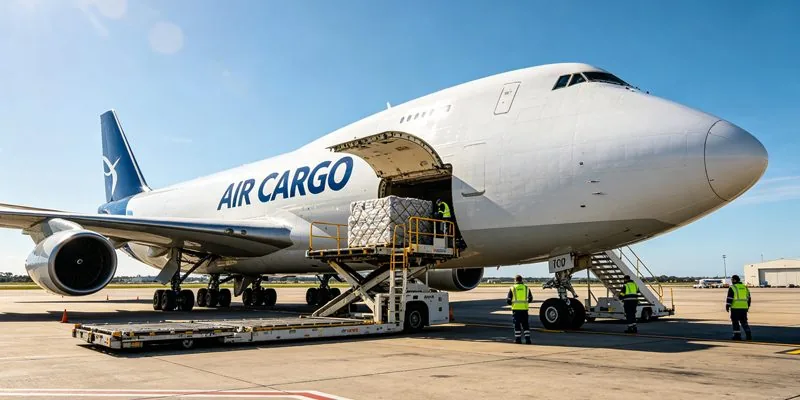
The question every US importer asks us about a new product is simple: "it has a battery — can it fly?" The real question is not whether it can fly, but under which identity it flies. The same cell shipped loose, packed with a device, or installed inside a device follows three different rule sets with different documents, different carriers and different aircraft eligibility. Get the identity wrong and you lose a week in a warehouse — or the whole shipment sits at the airport while your delivery window closes.
1. Pure Battery vs. Battery Packed With Equipment
The first fork in the road is one question: can this battery operate on its own, disconnected from a device? In air transport terms, that single fact decides almost everything downstream.
| Classification | UN number | Typical goods | Practical effect |
|---|---|---|---|
| Pure battery, shipped alone | UN3480 / UN3090 | Cells, battery packs, power banks | Fully regulated dangerous goods, most limits |
| Packed with equipment | UN3481 / UN3091 | Phone with spare battery, tool with a battery pack | Moderately restricted |
| Contained in equipment | UN3481 / UN3091 | Bluetooth earbuds, complete laptops | Usually the lightest restrictions |
| Equipment with button cells | Determined case by case | Motherboards, toys | Often assessed as general cargo |
Two practical consequences follow. First, if one consignment mixes finished devices with loose spare packs, pack and declare them separately — mixed cartons are frequently reclassified as pure battery, and you lose the lighter rules for no reason. Second, lithium metal (non-rechargeable) and lithium ion (rechargeable) use different UN numbers and different packing instructions. Do not assume one set of paperwork covers both.
2. UN38.3, MSDS and the Transport Report
These three documents are not duplicates. Each answers a different question, and missing any one of them usually stops the shipment at document review rather than at the airport.
| Document | Question it answers | Who issues it | Common trap |
|---|---|---|---|
| UN38.3 test summary | Did the cell or battery design pass the full test sequence? | Cell or battery manufacturer | Report model does not match the shipping model |
| MSDS / SDS | Composition, hazards, emergency handling | Manufacturer or a qualified lab | Outdated revision |
| Air transport conditions report | Can this consignment fly under the current rules? | Accredited third-party institution | Covers only one transport mode |
Some channels also ask for dangerous goods packaging certificates. The declared product name, model and watt-hour rating on your customs paperwork must match the report exactly. A document mismatch does not only cost you one shipment — it can cost your booking rights with that channel, and reinstating an account after a concealment finding is typically a long process.
⚠️ Packing instruction numbers, applicability conditions and quantity limits are revised periodically. Confirm the currently effective version with your carrier and testing institution before shipping; this article is a decision framework, not a legal reference.
3. PI965 to PI970: Mapping Six Packing Instructions
The decision order is fixed: first lithium ion or lithium metal, then whether the battery is packed with equipment or contained in it.
| Packing instruction | Applies to | Note |
|---|---|---|
| PI965 | UN3480, pure lithium ion | Strictest tier |
| PI966 | UN3481, packed with equipment | Battery is removable |
| PI967 | UN3481, contained in equipment | Most common, lightest tier |
| PI968 | UN3090, pure lithium metal | Metal equivalent of PI965 |
| PI969 | UN3091, packed with equipment | Metal equivalent of PI966 |
| PI970 | UN3091, contained in equipment | Metal equivalent of PI967 |
The PI966 / PI967 boundary is where most shippers slip: the test is whether the battery must be removed from the device before the device can be used — not what the box looks like. Within a single instruction there are also sub-sections with different net-weight caps and labelling. Confirm the applicable tier with your carrier, and when the answer is unclear, quote the stricter tier rather than relying on habit.
4. When Air Freight Is the Right Call — and When It Is Not
Air freight buys time and pays for it in restrictions and cost. That trade only makes sense for certain cargo profiles.
- Generally suited to air: high-value, low-volume goods (chip modules, precision instruments with backup cells, samples), urgent replenishment, and small consignments split across many batches. See air freight to the USA.
- Generally not worth forcing onto a plane: large stationary energy storage units, e-bike battery packs, bulk pure-cell orders, and routine replenishment with a stable lead time.
Three numbers decide it: watt-hours per unit, net weight per unit, and state of charge (SOC). Without those three, no quote or transit commitment means anything.
5. Ocean Freight Is Usually the Real Workhorse
A battery consignment that cannot fly often moves without trouble as a full container. The reason is structural: air transport applies aviation dangerous goods rules plus carrier-specific limits, while ocean transport follows the maritime dangerous goods framework, where full-container loading is comparatively workable and no passenger-belly constraint exists.
| Factor | Air (battery express line) | FCL ocean DDP to the USA |
|---|---|---|
| Governing rules | Aviation DG rules + carrier limits | Maritime DG rules + carrier requirements |
| Watt-hour and weight caps | Usually tighter; over the cap, refused | Looser; manageable inside a full container |
| Packaging and labelling | Verified carton by carton | Handled as one container plan |
| Transit time | Fast, suited to urgent cargo | Slower, but sailing schedules are predictable |
| Cost structure | High unit cost | Spread across volume |
| Typical use | Samples, line-down parts, high-value units | Peak-season stocking, high-capacity batteries |
The practical answer is a layered shipping plan: urgent quantities go by air to protect the delivery date, and the bulk moves FCL to hold the cost down. For the container side see FCL ocean freight, including loading and handover in South China.
6. Running Battery Cargo as an FCL Container
- Prefer FCL over LCL. Battery LCL cargo shares a container with unrelated freight and inherits its problems; a full container keeps loading and declaration under your control.
- Keep declarations consistent. The product name, model and watt-hour figure must match across booking, export declaration and US entry. Amendments are expensive.
- Prepare marine documents, not air documents. Do not reuse an air transport conditions report for an ocean shipment.
- Plan clearance and delivery together. Inspection probability tracks document completeness, so have a licensed broker pre-screen the file — see US customs clearance.
Coverage runs from Dongguan, Guangzhou, Shenzhen, Foshan, Zhongshan and Huizhou, China. Harmony Shipping Services Limited is a Dongguan, China-based forwarder with a US entity and bond, a licensed customs brokerage, and in-house trucking and rail delivery. Our team brings 15+ years of US trade lane experience.
FAQ
Q: Does battery cargo always need UN38.3 to fly? A: In most cases yes, and the tested model must match the shipping model. Final requirements depend on the channel and the testing institution.
Q: How much stricter is a pure battery than a battery packed with equipment? A: Pure batteries usually face more limits and fewer available channels, while packed-with and contained-in configurations are treated more lightly. Rates move with volume, channel and current capacity, so each shipment is costed individually.
Q: Can power banks fly? A: Units within the applicable watt-hour range are usually accepted; above it, most channels decline. Send the battery specification sheet first so we can confirm.
Q: Is FCL really easier than air for batteries? A: In most cases yes, though declaration and labelling still have to be compliant. The final call rests with the carrier and the customs broker.
Q: Under DDP, do I still need my own customs broker? A: No. Clearance and delivery are arranged by the carrier; you provide accurate cargo and battery data.
Q: How fast can a shipment be arranged? A: With complete documents, booking and warehouse receiving usually take a few working days; peak season and special categories can take longer. Schedules and flights are subject to the current period.
Next Step
Battery cargo fails on three mistakes: the wrong identity, the wrong documents, the wrong channel. Send us the battery model, watt-hour rating, net weight per unit, monthly volume and destination ZIP code, and we will recommend a combination of air express and FCL ocean shipping.
Email alan@hssddp.com with your product name and battery parameters for a tailored routing plan and cost assessment.