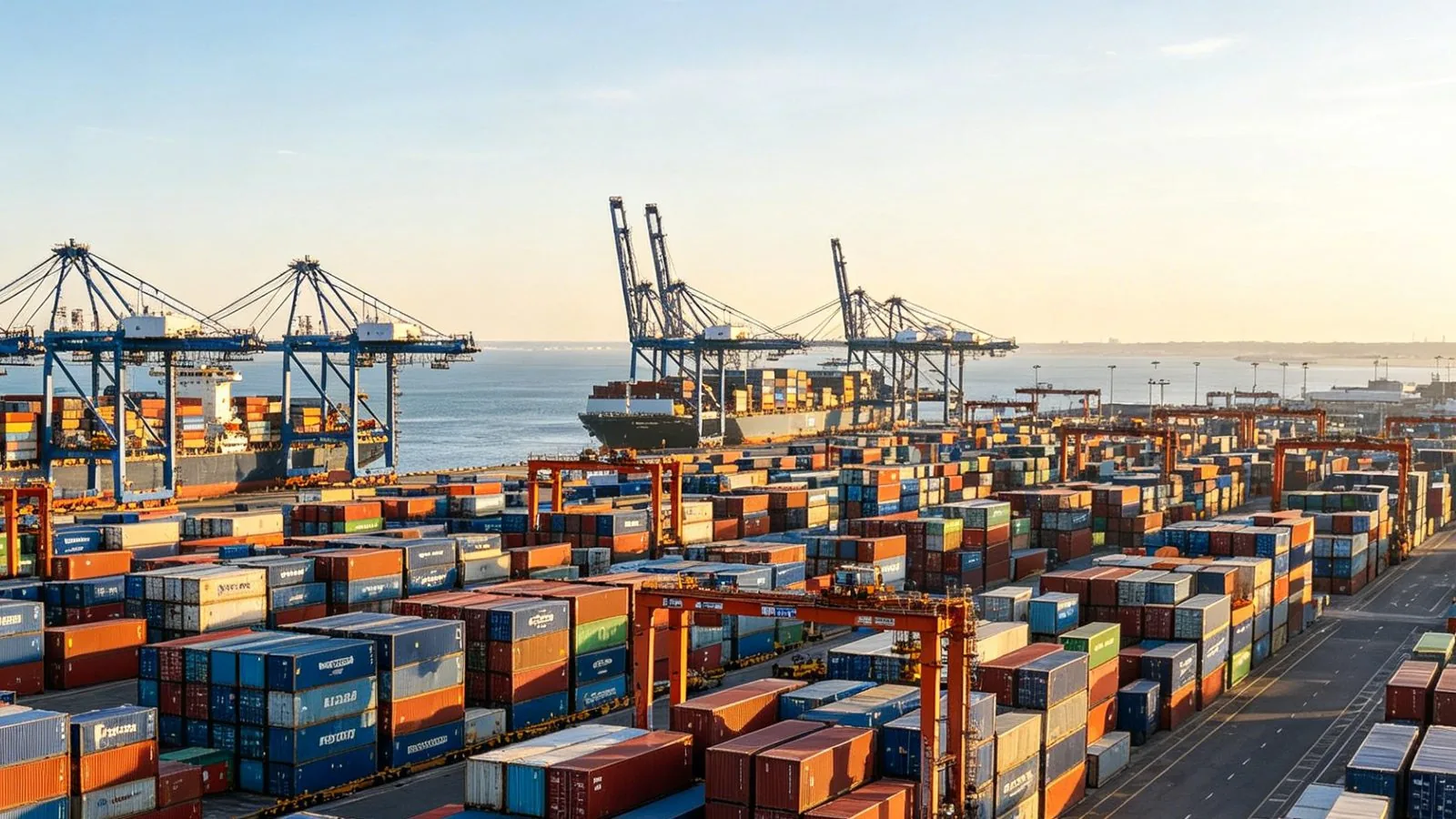
"How much is one container of USA FCL ocean freight?" is the question exporters ask most often. But a US-lane FCL rate is not a single fixed number — it is an ocean freight charge with a stack of local charges built on top. Understanding how a quote is constructed is the only way to avoid a cheap headline rate that ends up expensive.
1. The Four Components of a USA FCL Rate
| Component | What it covers | How it is charged | Common trap |
|---|---|---|---|
| ① Ocean freight | Port-to-port sea carriage | Per 20GP / 40GP / 40HQ, by trade lane (USWC / USEC) | Ocean freight quoted alone, with GRI and PSS unmentioned |
| ② Origin trucking and export declaration | Factory container pickup and loading, export declaration, manifest and AMS filing | Trucking by distance, declaration per shipment | Trucking charged at a "minimum call-out rate" |
| ③ Destination charges | US import clearance, ISF filing, duty payment service fee, terminal handling | Clearance per shipment, duty by HS rate | The big one: many destination line items, added one by one after arrival |
| ④ Delivery | Truck or inland rail from port to door | By distance and cargo volume/weight | Overweight, waiting time and re-delivery billed extra |
The key insight: plenty of quotes show only ①, which looks cheap — but ③ destination charges often run 20-50% of ①, sometimes more. Compare quotes on the door-to-door total, never on the ocean leg.
2. What a DDP All-In Price Actually Covers
Choose a US ocean FCL DDP shipping forwarder and all four components are bundled into one price — the quote is the door price.
| Step | Included in DDP? |
|---|---|
| Factory pickup, loading, trucking to port | Yes |
| Export declaration, manifest, AMS filing | Yes |
| Ocean freight | Yes |
| US import clearance, ISF filing | Yes |
| Duty and taxes paid on your behalf (including MPF and HMF) | Yes |
| US final delivery (truck / rail) | Yes |
| Customs examination fee | Only if selected for exam — billed at cost |
| Demurrage and storage | Only if container is not collected in time — billed at cost |
The real value of DDP: your landed logistics cost becomes predictable. You no longer reconcile a long list of destination charges after arrival, and there is no risk of a price increase once the cargo has sailed. For exporters who have to quote their own customers, that certainty matters as much as the number itself.
For how duty is calculated and how HS codes are classified, see How US import duty is calculated.
3. Five Variables That Move the Price
1. Trade lane: US West Coast vs East Coast
USWC (Los Angeles, Long Beach) runs about 12-15 days and is normally well below USEC (New York, Savannah) at 30-35 days. The same 40HQ can cost USD 2,000-4,000 more to the East Coast. If timing allows, USWC plus inland rail is often cheaper overall.
2. Container type
- 40HQ high cube — largest usable volume (about 76 CBM), best cost per unit for bulky cargo such as furniture and toys;
- 40GP — suits dense cargo, but watch the US inland per-container weight limit;
- 20GP — for smaller volumes or very dense cargo;
- Special equipment (OT / FR) — for over-height or over-width machinery, priced separately and needs booking ahead.
3. Season
Rates rise from July to October as GRI and PSS stack up. Locking space and price 3-4 weeks ahead is the single most effective saving.
4. Volume-to-weight ratio
FCL is charged per container, so a half-empty box is money lost. Shipping 55 CBM in a 40HQ wastes roughly 20 CBM of space; conversely, dense cargo can hit the weight limit and incur penalties. Choosing the right container for your volume-to-weight ratio usually saves more than negotiating the rate.
5. Port of loading and carrier
Yantian, Shekou and Nansha offer different sailing schedules and rates. Carriers such as OOCL, ZIM, WHL and Maersk also differ in pricing and space policy on the same lane. A forwarder with annual carrier contracts gets firmer pricing and better space.
4. Reading a Quote: Five Lowball Traps
Trap 1: Ocean freight only, surcharges unmentioned
The quote says "USWC 40HQ $X" but says nothing about the GRI effective date or whether PSS is included. The price rises after booking.
What to ask: which sailing date does this price apply to, does it survive a GRI taking effect, and is PSS included?
Trap 2: Destination charges left blank
"Destination charges billed at cost" means you cannot predict your total.
What to ask: a destination charge list before booking — clearance fee, ISF, terminal charges, duty payment service fee, either as amounts or a clear basis of calculation.
Trap 3: Trucking at a minimum call-out rate
"Trucking extra" can mean a minimum charge that makes short runs cost more than long ones.
What to ask: give the full factory address and require a door-to-door total that includes trucking.
Trap 4: No mention of overweight or waiting time
Overweight containers and queueing at the delivery warehouse both add charges.
What to ask: confirm the per-container weight limit (US inland is commonly around 17.2 tonnes including container tare, per carrier and rail rules) and whether delivery waiting time is free.
Trap 5: A suspiciously low duty figure
Some quotes show duty well below the market — that means an under-declared value.
What to do: refuse it. If US Customs examines the shipment, the storage, penalties and possible flagging for future examinations cost dozens of times what was saved. Compliant declaration is not optional.
5. What to Send for an Accurate Quote
Give these six items in one go and you save several rounds of back and forth:
| What to provide | Example | Why it matters |
|---|---|---|
| Cargo name | Outdoor furniture, LED lighting, injection moulds | Determines HS code, duty rate and whether FDA or FCC certification applies |
| Volume and weight | About 55 CBM / 12 tonnes | Decides container type and whether you will be overweight |
| Origin and factory address | Houjie, Dongguan, China; Shunde, Foshan, China | Calculates trucking cost and port cutoff time |
| Destination port or delivery address | Los Angeles, or a US ZIP code | Determines routing and final delivery method |
| Target shipping date | Mid-October | Matches sailings and shows whether peak season applies |
| Terms | DDP door to door / FOB / clearance only | Fixes the scope so nothing is missed |
6. FAQ
Q: How much is one 40HQ to the USA right now? A: Rates move with the market, so there is no fixed answer. Ask a US-lane forwarder for the current Yantian/Shekou rate to USWC or USEC and lock a price valid for the next 2-3 weeks.
Q: Why is the East Coast more expensive? A: Longer distance and tighter space — typically USD 2,000-4,000 more per container. If time allows, USWC plus inland rail is usually cheaper overall.
Q: Does the quote include US duty? A: A DDP door-to-door quote includes estimated duty paid on your behalf; the final figure follows US Customs assessment, reconciled up or down with a transparent statement. FOB or clearance-only quotes exclude duty, which the importer pays.
Q: How do I avoid a price increase after arrival? A: Use a US-lane forwarder that quotes a DDP all-in price, with the charge list set out in advance and written into the contract — stating what is included and what is billed at cost.
Q: FCL or LCL — which is cheaper? A: It depends on volume. Below about 15 CBM, LCL usually wins; above 15 CBM, FCL costs noticeably less per cubic metre, is faster and safer for the cargo, and far cheaper than air freight. See LCL vs FCL.
7. How We Can Help
Harmony Shipping Services Limited provides USA FCL ocean freight and DDP door-to-door pricing from Yantian and Shekou with direct carrier contracts — transparent rates, itemised and verifiable — serving exporters in Dongguan, Guangzhou, Shenzhen, Foshan, Zhongshan and Huizhou, China.
Send the six items above and we will return a door-to-door total including trucking within 24 hours.